Rocks & Rivers
Sep 27, 2026
The Concept
Rocks & Rivers is a game concept. You move a character from room to room, and each room has obstacles in it that are called hazards. Each time you play, you start in the first room and keep going until the character touches a hazard, and one attempt like that is called a run. The goal is to score as many points as you can in a single run.
Your score is determined by your Speed Level, which you get by picking up coins along the way. But watch out, if you try to get coins to increase your score, you could hit a rock, and its game over.
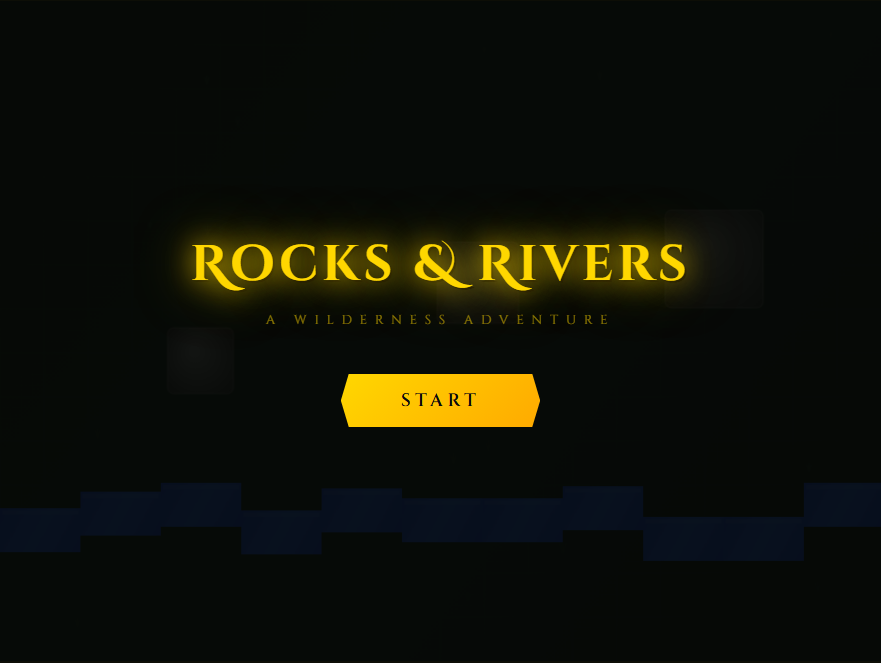
The current build is a prototype, meant to display the core mechanics of the game concept.
Movement
The character's position changes only while a directional input is held, at a displacement rate set by the character's speed level, a whole-number step that runs from the starting level up to a fixed maximum. Displacement stops at the instant of release and the position holds where the release occurred, a coupling of motion to live input called input-bound kinematics. The game does not feature gravity or momentum-bound physics in this incarnation, but could in future iterations. When you let go of an input, the character stops right where it is.
Scoring
A room transition occurs when the character's position crosses any edge of the current room, and each room transition adds to the run score a value equal to the character's speed level times 1, so if the player has 3 speed points, each room transition scores them 3 points.
The risk to reward proposition imposed to the player is moving at the edge is what earns the points but a faster exit is a riskier one, since you land in a room you're seeing for the first time with less time to react with more Ooopmph when you get there. This is combined with the fact that any room transition currently could land you on a rock as a luck component, and could impact your run negatively if you are too fast or too slow.
Speed
The way that I interpreted the game mechanics here, was a tradeoff between speed, scoring, and game over.
If you enter rooms at high speed, you score more points.
If you enter a lot of rooms at a high speed, you could end your run by accident by hitting a rock, but thats the same at lower speeds, giving the player a game theory risk benefit analysis moment they can use to personalize their game run impacts.
Rooms
Each room transition, the crossing of any edge of the current room by the character, discards the current room and generates a fresh successor, so every room is visited exactly once. The run score and the speed level are the only values carried across a transition, a structure called here: “the memoryless room sequence”.
Rocks & Rivers is an arcade game, so each room is a self-contained arena rather than part of a map, a path, or a progression. Your score and your speed are the two values you carry from one room to the next.
Hazards
A hazard is a static obstacle whose position is fixed for the life of its room, and first contact between a hazard and the character ends the run immediately, a rule called here: “single-contact termination” or “Insta-gib”.
Room generation places hazards independently of the edge and point at which the character enters, a placement rule called here: “entry-blind seeding”, so a hazard can sit at or directly beside the point of entry.
A single touch ends your run, and since hazards hold still, anything that makes a run harder comes from the speed you chose to pick up. Hazards are placed or spawn in without regard to where you come in on purpose, because a loss has to be possible in any room, your first or your last, which means a truly great run takes both skill and luck.
Slow Terrain
Rooms contain terrain that slows the character, called slow terrain, which multiplies the character's displacement rate by one minus a slowdown factor while the character is inside it. Each type of slow terrain carries its own slowdown factor, and the reduction applies to all displacement inside the terrain, including displacement toward a hazard.
Slow terrain slows you down while you're in it, and each kind has its own slowdown. Being in it slows your progress toward the next exit, and it also slows how fast you close in on any hazard nearby.
We have one type in this incarnation, the river type, and this serves as a strategic lever, the player can use it to slow down for transitions, or maneuvering navigation.
Direction
I'm putting Rocks & Rivers out there as a new possibility in game direction. This build is a prototype meant to display the core mechanics I have made here, such as arcade-style run management with instant game over potential.
The look and sound laid over the rules is called the skin, and the rocks and rivers could be swapped for anything, while still offering the cool potential for High Score being attainable by anyone if they give the game enough practice.
Hope you like it!
- Steve